
a conversation with:William Donahue

Reading Canetti

View the Course

Watch the course video

One novel. One vast book about crowds. Three volumes of memoir and thousands of aphorisms. Elias Canetti belonged to no school, answered to no discipline, and asked one question for seventy years: how do people come to believe what they believe, and what do those beliefs do to them?

Canetti’s life in six cities, the day that started his major work, the four men he named in Stockholm, and a reading list to keep beside you for four weeks.

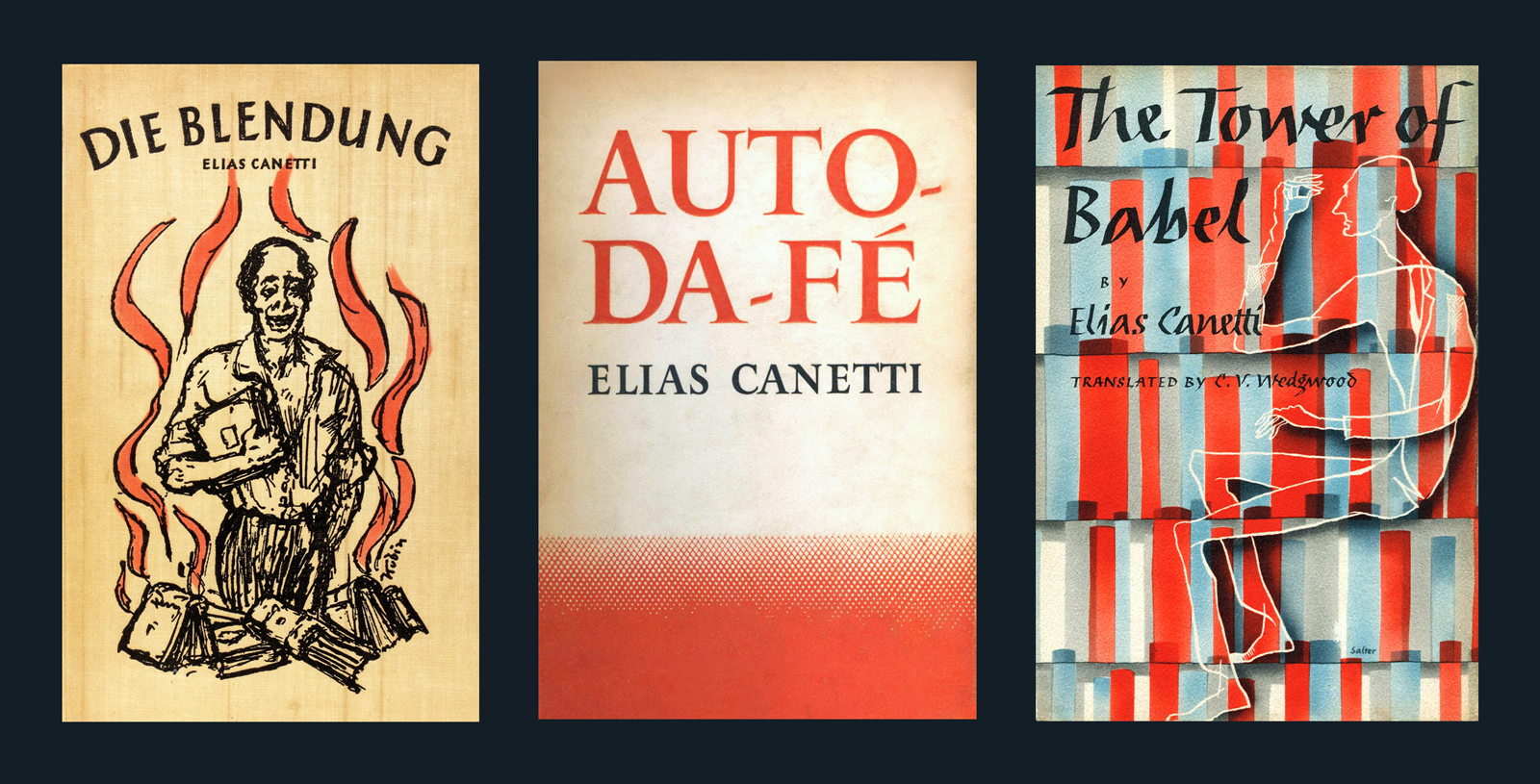
(From L to R): Die Blendung, Vienna, 1936 with binding by Alfred Kubin; 1946 London edition with a Jonathan Cape jacket; 1947 New York edition, with a cover design by George Salter.

One Book, Three Titles

The book, now known as Auto-da-Fé, appeared under three titles in twelve years. The German name and the English one do not mean the same thing, which is the first problem the novel hands you.

First was the German edition, published in Vienna in 1936 under the title Die Blendung — The blinding. But it also means the dazzle: the glare that stops the eye from seeing.

Next was the first English translation, published in London in 1946 with the title Auto-da-Fé — the act of faith — the Inquisition’s term for the ceremony that ended in fire.

The Tower of Babel was Knopf’s title for the first American edition, published in 1947. Later editions dropped it and went back to Auto-da-Fé, which the book has carried in English ever since.

Both English editions carry the same translation, by the historian C. V. Wedgwood, best known for her books on the English Civil War. She worked under Canetti’s personal supervision and hers has been the standard English text for eighty years.

A language he would not give up

Canetti was born into Ladino and learned English and French as a child. He settled on German at eight, because it was the language his parents used when they did not want the children to understand. He never gave it up. When he noted in 1944 why he would go on writing in the language of the people who had driven him out, the answer he gave was “because I am Jewish.”

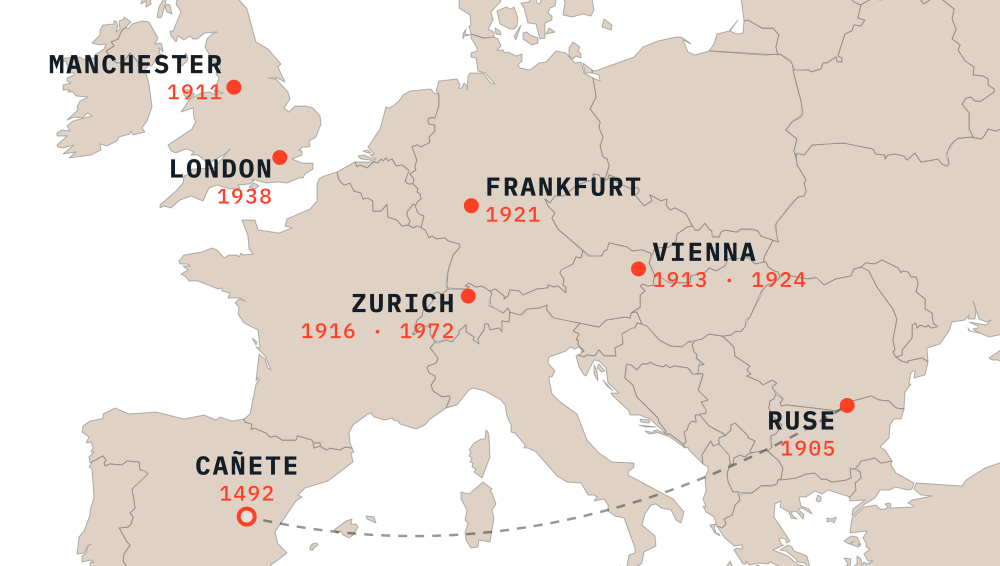
The six cities of his life, and Cañete, the Spanish town the family left in 1492. The dashed line spans the four centuries between.

A Life in Transit

1905 • Ruse

Born on the lower Danube in Bulgaria into a Ladino-speaking Sephardic family. The name comes from Cañete, the town the family left in 1492.

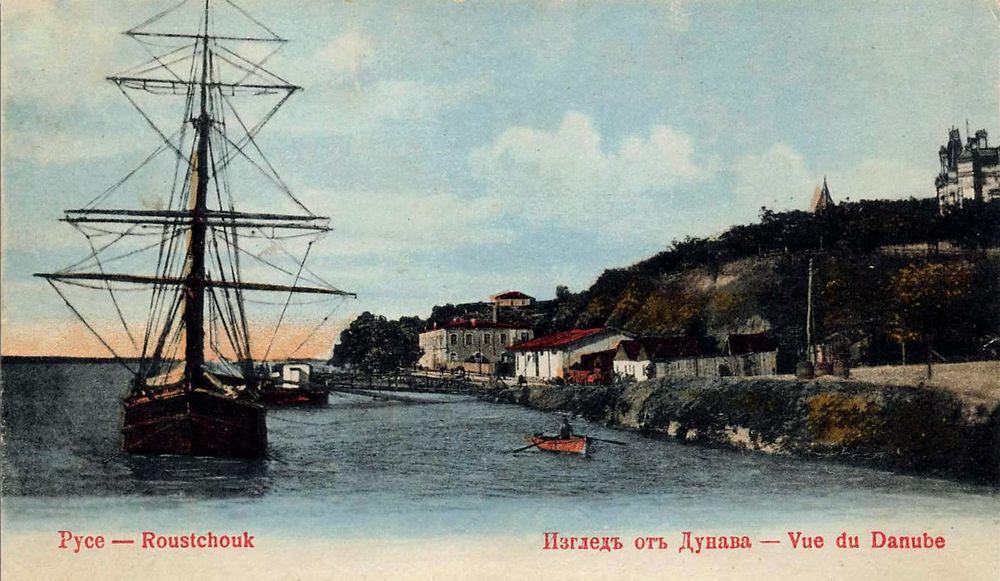
Ruse on the Danube. Where Canetti was born in 1905. The postcard is captioned in Bulgarian and in French.

1911 • Manchester

His father moves the family to England. He is six, and it is the first of the uprootings that structure his childhood.

1913 • Vienna

His father dies suddenly. Canetti treated that death ever after as the event against which all others were measured.

1916 • Zurich

The school years he remembered most warmly. His mother pulls him out in 1921 for fear he is becoming too content.

1921 • Frankfurt

He finishes high school through the inflation years. In 1922 he protests after the killing of Walther Rathenau and feels a crowd close around him for the first time.

1924 • Vienna

He hears Karl Kraus read, takes a doctorate in chemistry in 1929, never works as a chemist, and finishes his novel in the early 1930s.

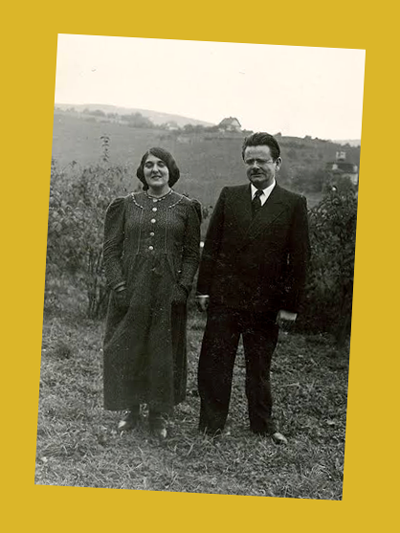
Veza and Elias Canetti. They met at a Karl Kraus reading in 1924 and married in Vienna in 1934. Through the early 1930s she published stories and a serialized novel under pen names. Her books reached print only decades after her death.

1938 • London

He and his wife, the writer Veza Taubner-Calderón, leave Vienna in November, days after Kristallnacht. He stays close to forty years.

1972 • Zurich

His last two decades, back in the city of his best childhood years. The Nobel comes in 1981. He is buried at Fluntern in 1994, steps from James Joyce.

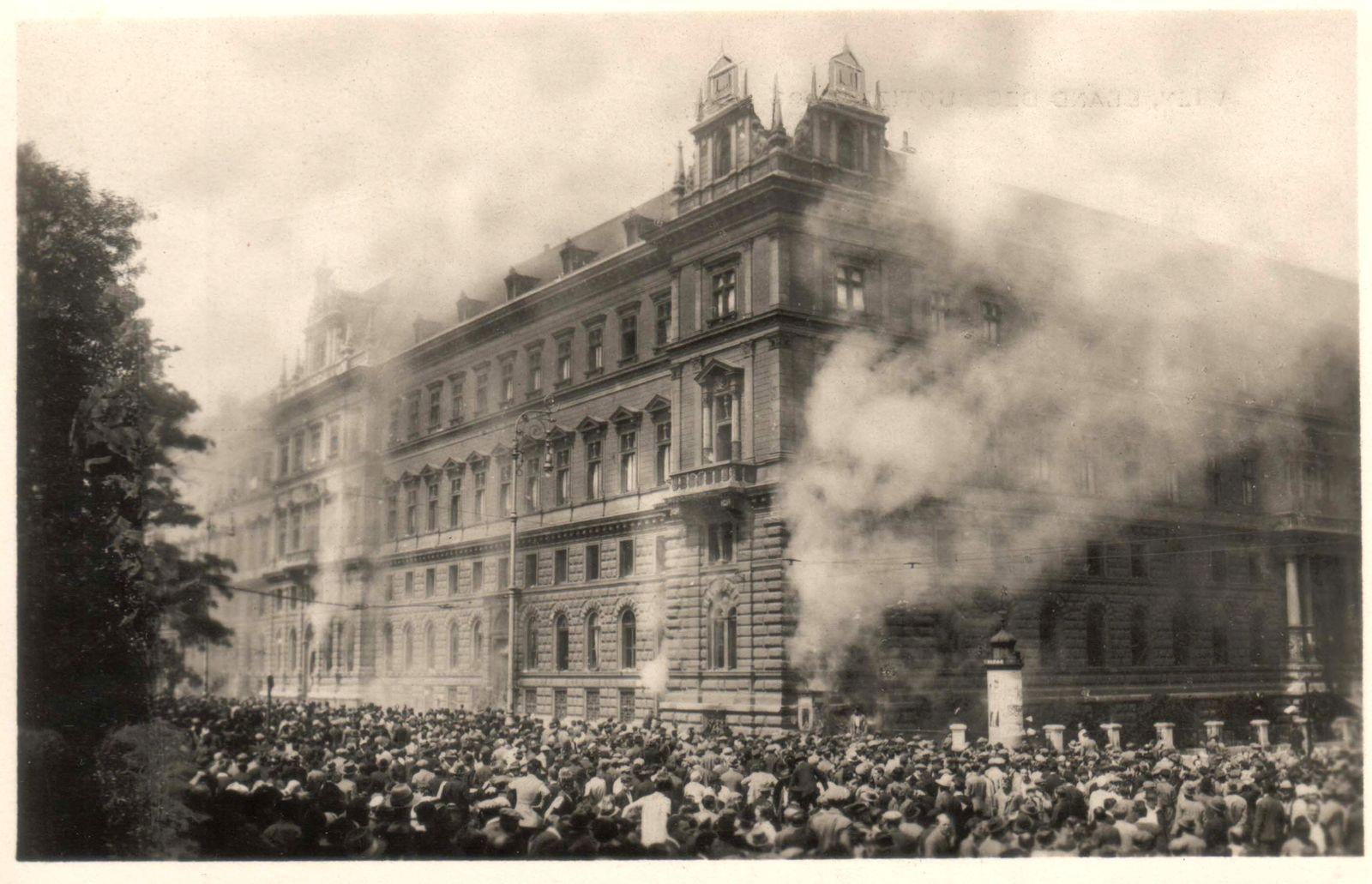
The Justizpalast, or Palace of Justice, aflame in Vienna, 15 July 1927.

The day the Palace of Justice burned

The Origin of a Book

In January 1927 right-wing paramilitaries fired on a Social Democratic march in the Burgenland village of Schattendorf, killing a disabled veteran of the First World War and a boy of eight. In July a Vienna jury acquitted them.

The city went into the streets. A crowd filled the Ringstrasse and massed in front of the Palace of Justice. By midday the building was burning, and the firefighters who reached it were driven off with their hoses cut. The police were ordered to fire into the crowd. Eighty-nine people were killed.

Canetti was twenty-two and he was in that crowd. Fifty years later he wrote that it had been the most decisive day of his life “since the death of my father.” For Canetti there was no higher measure.

The crowd he stood inside had no leader, no organizer, and no plan, and it acted anyway.

He spent the next thirty-three years on that problem. The answer was Crowds and Power, published in 1960, a book that borrows from anthropology and history and belongs to neither. He said afterwards that the novel had come out of the same fire.

This matters for the course. Auto-da-Fé is usually described as a book about a scholar who loses his mind, and it is. It is also where Canetti first takes up the question that held him for the rest of his life: what happens to a mind that has shut the world out. He finished the manuscript in 1931, four years after the fire.

In Conversation

William Donahue on Elias Canetti

Donahue is Cavanaugh Professor of the Humanities at the University of Notre Dame and directs the Initiative for Global Europe in the Keough School of Global Affairs. His The End of Modernism: Elias Canetti’s Auto-da-Fé is the standard study of the novel. We asked him what a first-time reader should watch for.

If someone has never read a page of Canetti, what would you tell them about Auto-da-Fé to spark their curiosity?

If you think a novel can be dark, funny and philosophical all at once, this may be the book for you. Like literary modernism in general, however, this work asks a lot of its readers. So be prepared for a book that means to try your patience, cause you to stumble, and make you self-conscious about your reading. (And don’t despair if you don’t plow through it all at once; Canetti enjoyed giving public readings of just short excerpts.)

Canetti, when asked why he wrote in German, the language of the peoples that had driven him into exile, famously answered, “Because I am Jewish.” Do you think Canetti regarded his work as Jewish, or in conversation with Jewish themes?

Canetti was one of those fully acculturated German Jews who both embraced his Jewish identity and was baffled by it. He was wary of being labeled as an ethnic or niche author, that is as “merely” Jewish. In Crowds and Power (Masse und Macht) he attempted to lay out key “national” traits of a variety of groups of people, but faltered when it came to Jews, who he claimed were a people more likely to keep probing and debating their identity than to embrace an agreed-upon national symbol.

Canetti isn’t often discussed alongside writers like Kafka or Benjamin, yet this course places him firmly within Jewish modernism. Why do you think Canetti isn’t as widely read as some of his contemporaries?

Canetti is in fact often discussed in connection with Franz Kafka and increasingly with Theodor W. Adorno. (The new Cambridge Companion to Kafka will have a chapter devoted to Canetti and Kafka.) Kafka was without a doubt Canetti’s favorite author, and he said as much when, in 1981, he essentially “shared” his Nobel Prize for Literature with Kafka (along with Jewish writers Hermann Broch and Karl Kraus). One of Canetti’s best-selling books is called The Other Trial; it is actually a two-part essay that takes Kafka’s Letters to Felice as a springboard for exploring the importance of Kafka. Canetti actually helped Kafka to achieve his status as the perhaps best known writer of the 20th century.

After spending so much time with Canetti, has he influenced how you think, not just what you study?

Absolutely, and probably in ways I am not fully aware of. Canetti lived the examined life to the hilt, recording in his daily writing (Aufzeichnungen) a rich and creative array of literary reflections: maxims, aphorisms, sketches, queries, confessions, poems, dialogues, impersonations, jokes, etc. He would typically refer to himself in the third person, creating a distance that allowed him to conduct a kind of conversation with what he called “my ferocious partner” (“der grausame Partner”).

Why do you think Auto-da-Fé might particularly resonate in 2026?

If Auto-da-Fé continues to resonate today, it is probably because the central paradox of interpretation, something we all experience every day, is expressed, rehearsed, and illuminated in memorable, humorous, and sometimes painful ways. We don’t simply watch others (in this case, literary figures) go through this; we as readers experience the dilemma ourselves. The second great point would be the novel’s interrogation of learning, the humanities, teaching and scholarship. What are their real potential? How are they actually deployed?

Canetti’s novel is known under a few different titles, Die Blendung being its original, German-language title; The Tower of Babel its title when first released in English translation; and Auto-da-Fé what it is known as today amongst English-language audiences. One wonders why Die Blendung was not simply translated into “The Blinding” or, perhaps, “The Glimmer.” Do you think Canetti’s original German title was significant to understanding the work, and is something lost or gained in translation?

I think the German title, Die Blendung (The Blinding), does a much better job of getting at the central hermeneutical thematic, the problem of interpreting when we have to rely on our own partial and prejudiced perspective. But the “English” title, the one now generally used for the English translation by C. V. Wedgwood, has some advantages too because it shifts our attention to the final conflagration. This is perhaps better discussed once we’ve actually read the novel!

Auto-da-Fé is probably not often described as a beach read. Yet as a novel it has a great deal to say about our most passionate feelings and how that impacts the narrator’s personal life, and particularly about the “problem of wisdom.” What is the wisdom problem that Canetti’s novel articulates or describes?

Not a beach read at all! It is often demanding and sometimes outright frustrating. But funny, too, in a way that most modernism is not. Moritz Baßler describes modernist prose in general as intentionally “sperrig” (cumbrous), and this is certainly true of Canetti, whose characters will, for example, give well-worn proverbs a hilarious, nasty, or unexpected twist. But this is not gratuitous: it facilitates our own reflection on the unavoidable challenge of meaning-making. For this reason, Canetti can indeed be placed within the broader context of “wisdom literature.” But he would more likely have seen the prophets of the Hebrew Bible as his literary forebears.

If you could ask Canetti one question over coffee, what would it be?

I did in fact ask Canetti a series of questions, in a letter, when I was a student. And he answered me! More in person …

About the Author

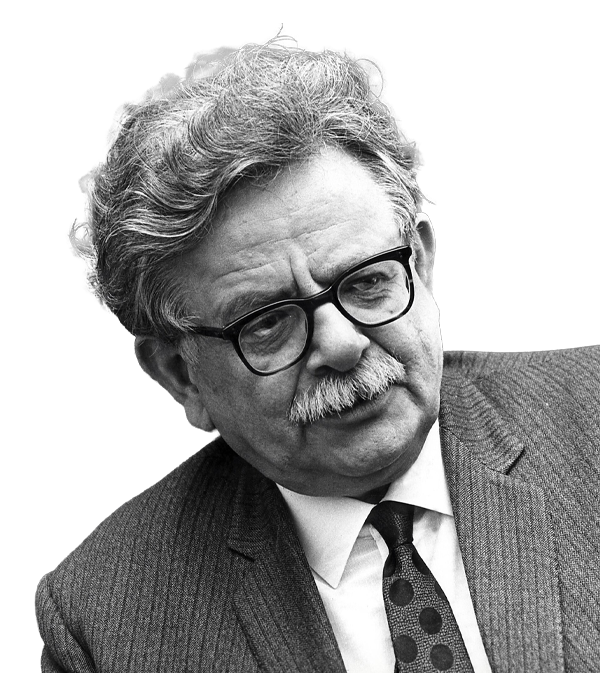
Elias Canetti

Elias Canetti (1905–1994) was born in Ruse, Bulgaria, into a Ladino-speaking Sephardic family and grew up in Manchester, Vienna, Zurich, and Frankfurt. German, the fourth language of his childhood, remained his literary language for the rest of his life. He took a doctorate in chemistry at the University of Vienna and published his only novel, Die Blendung, known in English as Auto-da-Fé, in 1936. He left Vienna for London in 1938, lived in England for nearly four decades, and became a British citizen in 1952. Crowds and Power appeared in 1960. His other work includes plays, the travel book The Voices of Marrakesh, decades of notebooks and aphorisms, and a three-volume memoir beginning with The Tongue Set Free. He received the Nobel Prize in Literature in 1981 and spent his last years in Zurich, where he died in 1994.
makeityours

Membership puts you at the center of what we do

  • 01⅔ OFF ALL PROGRAMS
  • 02ON-DEMAND LEARNING WITH OUR VIDEO LIBRARY
  • 03ADVANCE NOTICE FOR ALL SPECIAL EVENTS
Support us